
Alumni Stories: Elisabeth Kim
The Education Diagnostician
Elisabeth Kim is using a range of methods to learn what families really want from local schools
September 2022
Elisabeth (Betsy) Kim grew up with a single mom who suffered from mental health issues. The family moved frequently, and when Kim was in first grade, she was adopted by her aunt and uncle.
“School was the one constant for me, something I was good at and where I felt safe,” recalls Kim (CPRL Fall 2015).
Kim was powerfully reminded of her childhood experiences when she began teaching during the early 2000s at P.S. 161 in Harlem in New York City. “By chance, my students were also first-graders, and many of them had difficult home lives, too. When they came back from school breaks, they were so happy to be with their friends in a structured environment.”
Yet Kim soon became convinced that the education policies of the day were threatening the function of school as a sanctuary. The recently passed No Child Left Behind Act (NCLB) had increased the focus on standards and accountability, disaggregating test scores by sub-populations (e.g., Black, Latinx, female) to ensure equity in serving all students. It was a good idea, Kim says, but in practice, NCLB was being used as “a blunt instrument” for punishing schools in the short term rather than helping them to improve over time. “We were constantly afraid that the district was going to penalize us or even close the school. It just seemed like the focus was on the wrong things.”
Kim has since changed her own focus to research, earning a master’s in Sociology & Education and a Ph.D. in Education Policy from Columbia University’s Teachers College. She also supplemented her strong qualitative skills with a master’s degree from Columbia in quantitative methods in the social sciences. In those roles, and now as a Robert Curvin Postdoctoral Associate at the Joseph C. Cornwall Center for Metropolitan Studies at Rutgers University-Newark, she has continued to explore the purposes that schools serve for families and students in marginalized communities.
For example, for her doctoral dissertation, which she completed while at CPRL, Kim explored how Latinx families were navigating school choice in New York City. Her approach was qualitative, but she has since done mixed methods research with the data. (She recently submitted a paper on kindergarten school choice in New York City to a peer-reviewed journal.)
“Many immigrant families lack the information or the means to go on tours and do all the other things necessary to engage with that process,” she says. “Most choose schools that are in their neighborhoods. In fact, one woman I spoke to had learned about her children’s school when she was still in the Dominican Republic, because her relatives in New York were sending their kids there.”
Yet, much as Kim had feared as a teacher, the district was disregarding the importance of such community attachments. One school she studied in Brooklyn had been closed for low test scores and then relaunched “with great fanfare” under a new name. Latinx families told Kim that they preferred the original school, where the administration and teachers had often worked with their children’s older siblings, had local roots and understood the community’s needs. (Many White families weren’t even aware of that history: One parent told Kim, “I’m so glad this school just fell out of the sky.”)
Compounding the problem: As the district closed and then relaunched “failing schools,” it wasn’t connecting Latinx families with dual language programs, which can greatly boost the academic success of children who are English language learners. “When I spoke with these families, it became clear that their local schools typically did not offer dual language programs and when they did, they either weren’t aware of them or else saw them as being like Gifted and Talented programs. They assumed that the programs were intended for children from higher-income, mostly White families.”
Kim was fluent in Spanish, having previously worked in the Peace Corps in the Dominican Republic and taught in the dual language program at PS 161. Still, she credits CPRL, where she was a student as well as a teaching assistant and research assistant, with giving her additional skills to diagnose and address these kinds of issues.
“CPRL really emphasizes the importance of speaking with all stakeholders,” she says. “So instead of just posting a flyer to recruit people, I contacted an afterschool program housed at one of the schools, and I came to a parent meeting. I introduced myself in English and Spanish, then followed up for interviews.”
CPRL’s Evolutionary Learning approach has also given Kim a framework for pursuing deep and sustainable change. In her CPRL seminar, she absorbed the ideas of the systems scientist Peter Senge, who argues that the most effective organizations enable their people to continually adapt and learn new ways to get the results they desire. With Elizabeth Chu (now CPRL’s Executive Director) as her project director, she applied those ideas in her student project, co-designing an instrument for a mid-sized family foundation to use in assessing the readiness of grant-seeking organizations to undertake proposed projects.
“The foundation was undergoing a shift to become a learning organization with a whole-child focus, and it wanted to ensure that its grantees were learning organizations as well,” she says. “We interviewed foundation staff and peer organizations and then wrote a report on philanthropic monitoring and evaluation that sought to provide a snapshot of past and current approaches to strategy and evaluation in the philanthropic field. Ultimately, we created a rubric comprising financial health, governance, leadership and learning organization capacities.”
As a Robert Curvin Postdoctoral Associate at the Cornwall Center at Rutgers-Newark, Kim has continued to provide organizations with this kind of granular, real-time feedback. In one project, she’s supported the Newark FAFSA Challenge, an initiative to help Newark high school seniors complete the complex Free Application for Federal Student Aid (FAFSA) or the New Jersey Alternative Financial Aid Application for New Jersey Dreamers. Previous research has shown that students who complete these forms are more likely to attend and complete college, but also that FAFSA completion rates are lower among students of color and those from immigrant families.
In a recent report she authored, Kim found that in Newark, where young people of color make up more than 60 percent of the student population, FAFSA completion has dropped significantly since the onset of the COVID-19 pandemic. Her report reviews strategies that other states and cities have used to boost completion rates, including making FAFSA completion a mandatory requirement for high school graduation, creating exemptions for undocumented students and other special populations, and increasing support from school counselors.
In another project for the Cornwall Center, Kim is helping to launch Freshman Success, a professional development program to help educators support students’ success in the ninth grade (an outcome linked to higher likelihood of graduating from high school on time). She is working with a data team in the district to create a tool to track students’ progress. She’s also creating a tool to track note-taking by “Networked Improvement Communities”—teams of teachers, principals, freshman year guidance counselors and central office staff.
“It’s easy for these teams to get derailed and focus on things outside their locus of control,” she explains. “By monitoring their notes, we can see if they’re focused on the task at hand. It’s better than waiting until the end to assess how things are going.”
These methods are complex and labor intensive, especially compared to the accountability measures of simply setting a target and leaving it to schools to sink or swim. But Kim believes that making a school both stable and successful requires sustained effort.
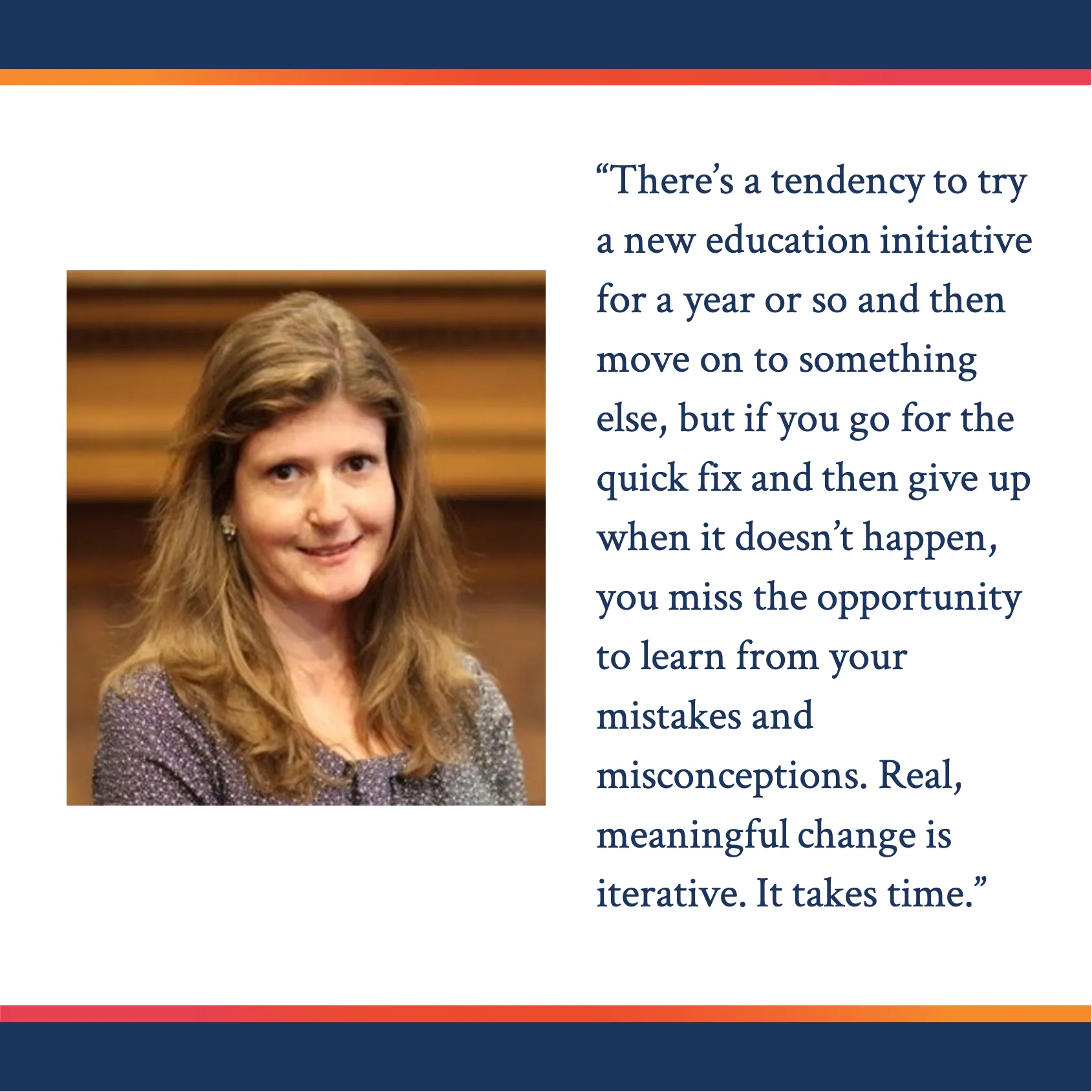
“There’s a tendency to try a new education initiative for a year or so and then move on to something else,” she says. “But if you go for the quick fix and then give up when it doesn’t happen, you miss the opportunity to learn from your mistakes and misconceptions. Real, meaningful change is iterative. It takes time.”
In Their Own Words
Our alumni network now includes more than 500 leaders, advocates, and champions dedicated to improving school systems and other public sectors. Some alumni work directly with teachers, families, and students, ensuring access to high-quality education. Others work indirectly—supporting improvement from inside private sector organizations. In Their Own Words captures the many and varied ways our alumni lead and improve organizations in education and other public sectors.
About the Author
Joe Levine writes about education, law, science and medicine, and health care. His work has appeared in Time, LIFE, Money, Newsday, and many university magazines.