
Alumni Stories: Marti Morgan
The Courtroom Educator
For Marti Morgan, public defense law is Ground Zero for addressing issues of inequity and fairness America
October 2022
During her second year at Columbia Law School, Marti Morgan (CPRL 2011) took a course on death penalty law with James Liebman, Simon H. Rifkind Professor of Law, that gave her sudden clarity about her future path.
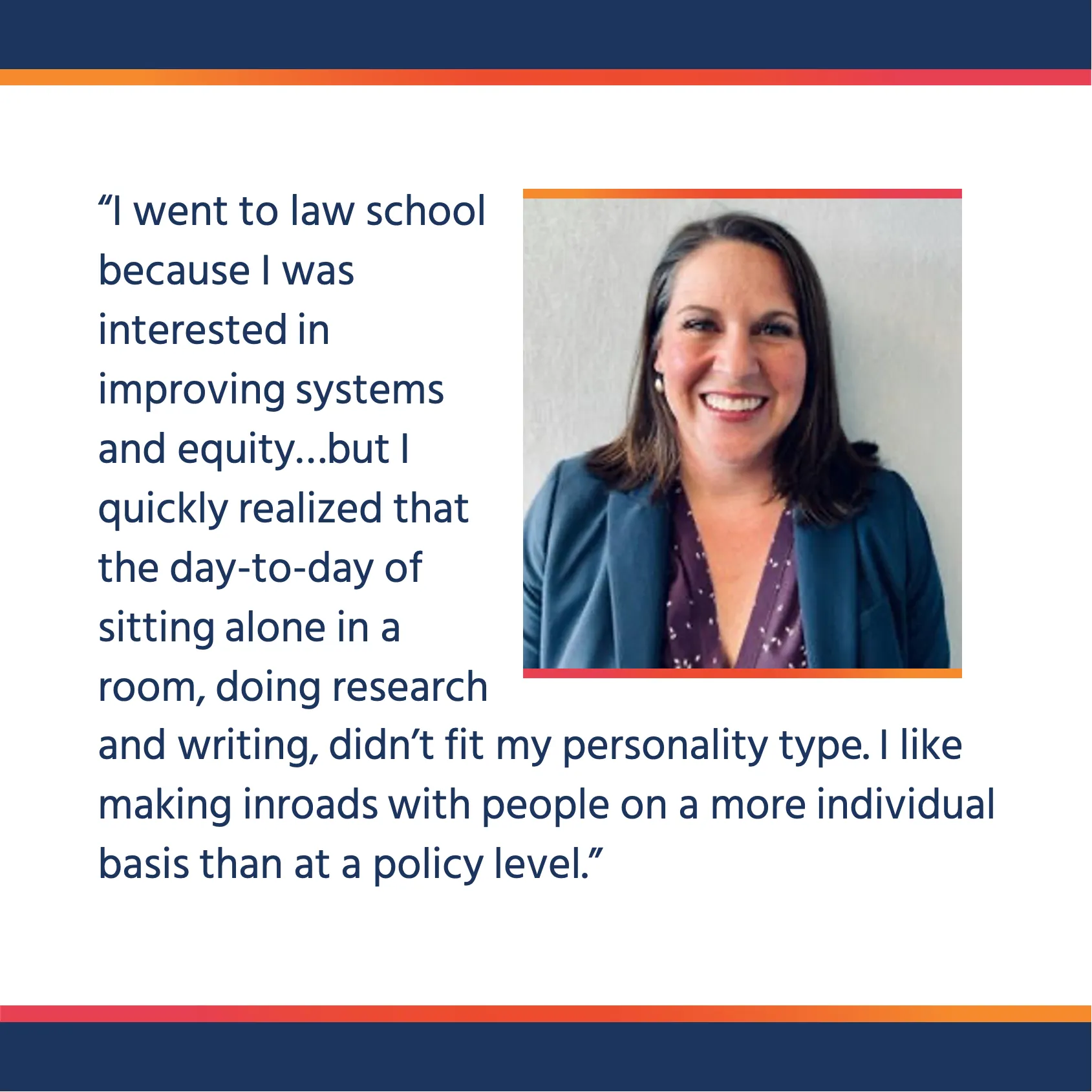
“I went to law school because I was interested in improving systems and equity,” Morgan recalls. “My first summer I worked on litigation reform at Planned Parenthood. It was incredibly important and interesting, but I quickly realized that the day-to-day of sitting alone in a room, doing research and writing, didn’t fit my personality type. I like making inroads with people on a more individual basis than at a policy level.”
Liebman’s class helped point her toward public defense law, a field that is arguably Ground Zero for issues of fairness and social justice in the United States. It also had an added attraction for a former high school teacher who missed the classroom—one in which “you interact with lots of people, and you’re not sitting still.” Shortly afterward, when Liebman founded the Center for Public Research and Leadership, Morgan joined the first cohort. She has continued to draw on both his course and her CPRL experience in her subsequent work as Assistant Public Defender in the Miami-Dade State Public Defender’s Office and, currently, as Assistant Federal Public Defender in the Northern District of Texas—roles in which she has focused predominantly on defending juvenile clients who have been charged as adults in non-homicide cases.
“Death penalty case law is the basis of so much of the case law in my practice because it’s so heavily litigated,” she says. “I can pull from fairly recent decisions such as Miller [Miller v. Alabama, a 2002 Supreme Court ruling prohibiting sentencing schemes that mandate life without parole in cases where a juvenile is convicted of homicide] and use them in broader ways to help clients who are probably in some of the worst spots in their lives.”
Morgan has also employed CPRL’s Evolutionary Learning framework, for changing systems through close observation of people's on-the-ground experiences. The approach proved particularly useful in Florida, which is one of only a handful of states that allow lawyers to take depositions in criminal trials.
“In felonies, I could call in cops, victims, witnesses or anyone who had information to give about elements of the crime,” she recalls. “That really levels the playing field between prosecution and defense, because you can ask about anything, including motivations. You learn about reality instead of everyone just sticking to the official story.”
Morgan has also learned to focus her attention on the person wielding the gavel.
“In Miami, each courtroom was unique. Everything depended on knowing your judge and your prosecution audience, because you can build mitigation by educating them that, hey, you can throw out that 10-year mandatory sentence and give the defendant a second chance of some sort—a juvenile program or boot camp, which may be tough, but is a whole lot better than what they were looking at.”
Morgan also learned from her fellow public defenders, because “the caseload was so big, and each of us was seeing different trends and pressure points that could be turned to an advantage for our clients.”
Each of these interactions required proficiency in another CPRL competency: developing the communications skills to engage with a range of stakeholders.
“Adjusting your communications strategies for different players and jobs is key,” Morgan says. “Clients are not a monolith – they’re individuals, and how I talk to them is different from how I present and act with judges, especially here in Texas in the federal system. There’s so much formality, rigidity and insulation at the federal level, which makes it easier for judges to send people away for long periods of time. A judge may only see a defendant once, to sentence them, which seems bonkers to me.”
In general, Morgan describes her work at the federal level as more sobering than her state-level experiences, though the lessons have been perhaps even more valuable.
“In the federal system, you feel like there’s less you can do to help people—the wheels are just grinding on your client, because there’s no negotiation,” she says. “The other side cherry-picks cases that have been vetted six ways to Sunday.” And the punishments are “draconian,” because under statutes such as the Armed Career Criminal Act [ACCA], a guilty verdict requires judges to impose lengthy minimum sentences on defendants with three or more prior convictions for violent felony or serious drug offenses.
“With the right priors and nonviolent possession of a firearm, like if you’re pulled over with a gun in your car when speeding or if the arresting officer says the car smells like marijuana, the judge has to give you 15 years,” Morgan says.
Another federal firearms statute, §924(c), imposes additional minimum sentences when a firearm is used or possessed during another federal crime of violence or of drug trafficking. “So, if you’re selling crack and have a gun, that’s five years on top of the drug sentence and seven if anyone sees the gun and 10 if you pull it out.”
The underlying issue with all of these harsh measures, Morgan says, is that they are selectively enforced and prosecuted. ACCA and 924 C tend to be applied more frequently in red states than blue ones and the arrests that trigger their use reflect longstanding societal inequities.
“Race and class often determine who gets pulled over on the highway,” she says, “and the statistics show that the same is true regarding who gets prosecuted.”
Despite the daunting nature of her work, Morgan plans on staying in the field of public defense and, beyond advocating for her clients in the courtroom, fighting for specific changes in the system. These include reducing or eliminating minimum mandatory sentences, expanding awareness of racial and socioeconomic disparities in policing and prosecution, and promoting a more compassionate understanding of addiction.
“In the state system, there were more options for sentences that had an eye toward rehab, even if the rehab was kind of crummy. The programs were legitimate in that they did drug rehab, they did diagnosis. But here in northern Texas, there’s nothing like that. It’s just lock ‘em up. And marijuana needs to be legalized across the board. It’s too easy for the police to get details that gain them access to every part of a person’s body or car. ‘I smell marijuana’ is hard to refute.”
Morgan concedes that the chances of changing these dynamics any time soon are not great, especially in states like Texas. “The public here is actually in favor of legalizing marijuana, at the very least for medical purposes. But in the interest of pleasing a certain part of the population, the Texas legislatures, which are much more red, just kill it time after time.”
So, what keeps her going? The system may deal out defeat every day, she says, but “the way to not be ground down by it is to use what you learn and share it.
“I find it useful to get mad rather than sad—to focus on the wins, even if they’re small,” she says. “Also, it’s so important to have great colleagues to be indignant with and to reaffirm that your clients are human beings.”
In Their Own Words
Our alumni network now includes more than 500 leaders, advocates, and champions dedicated to improving school systems and other public sectors. Some alumni work directly with teachers, families, and students, ensuring access to high-quality education. Others work indirectly—supporting improvement from inside private sector organizations. In Their Own Words captures the many and varied ways our alumni lead and improve organizations in education and other public sectors.
About the Author
Joe Levine writes about education, law, science and medicine, and health care. His work has appeared in Time, LIFE, Money, Newsday, and many university magazines.